Inference pipeline
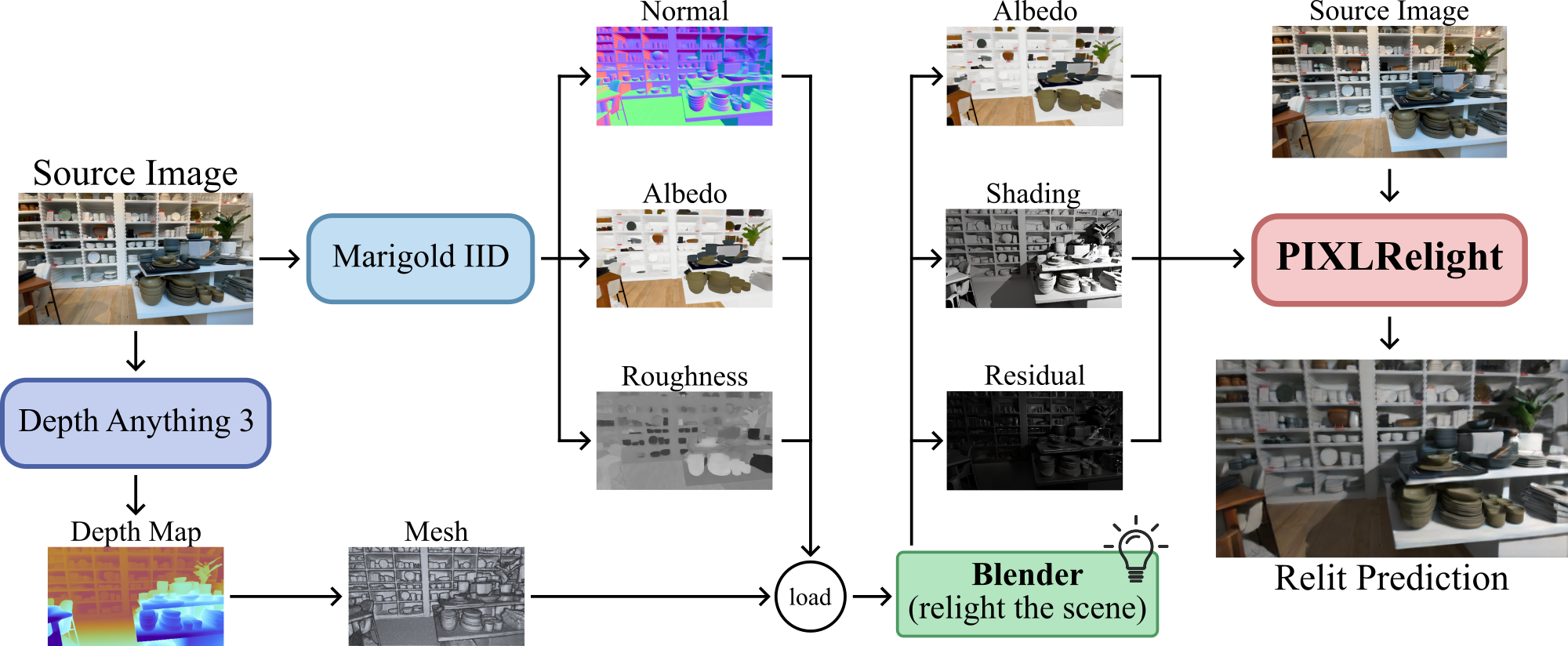
Move your cursor across the image to reposition the light. Use the scene buttons to switch scenes, and the light buttons to switch between flash and spotlight.
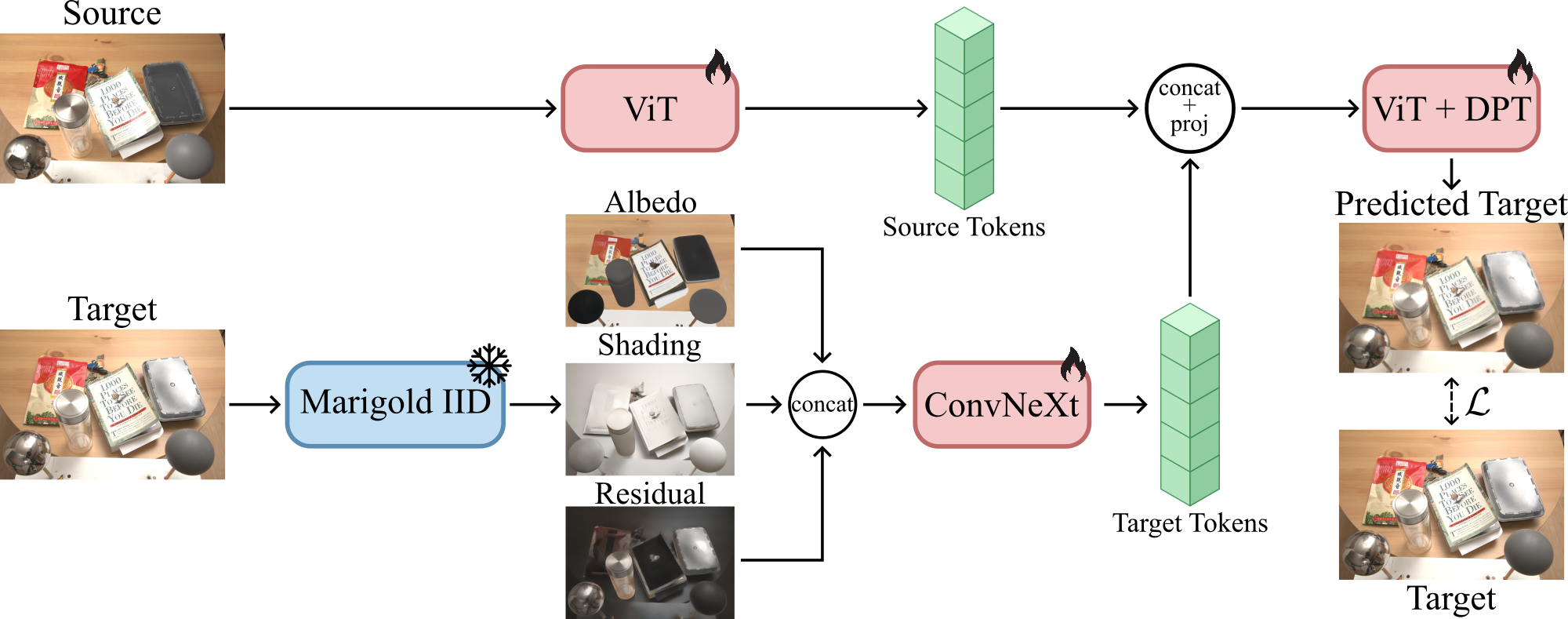
We present PIXLRelight, a feed-forward approach for physically controllable single-image relighting. Existing methods either provide limited lighting control (for example through text or environment maps), accumulate errors when chaining inverse and forward rendering, or require costly per-image optimization. Our key idea is to bridge physically based rendering (PBR) and learned image synthesis through a shared intrinsic conditioning that can be obtained from either real photographs or PBR renders. At training time, paired multi-illumination photographs are decomposed into albedo, diffuse shading, and non-diffuse residuals, which condition the model. At inference time, the same conditioning is computed from a path-traced render of a coarse 3D reconstruction of the input under user-specified PBR lights. A transformer-based neural renderer then applies the target illumination to the source photograph, preserving fine image detail through a per-pixel affine modulation. PIXLRelight enables arbitrary PBR-style lighting control, achieves state-of-the-art relighting quality, and runs in under a tenth of a second per image.
Drag the slider in each panel to compare our result against prior work and a path-traced render. Use the scene buttons to change scene.
        @article{farinha2026pixlrelight,
          title   = {PIXLRelight: Controllable Relighting via Intrinsic Conditioning},
          author  = {Farinha, Miguel and Clark, Ronald},
          journal = {arXiv preprint arXiv:2605.18735},
          year    = {2026}
        }